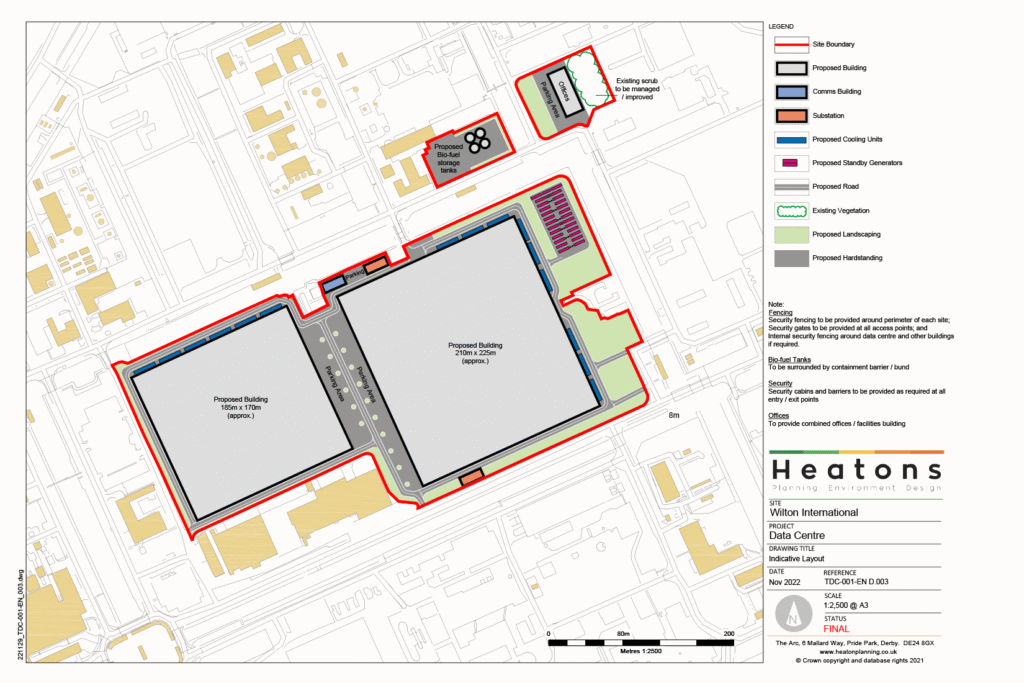
Heatons have gained planning permission for a new data centre in Teesside. Heatons coordinated and submitted the planning application for the ambitious data centre which encompasses a state-of-the-art data centre complex, which will include not only the main data centre buildings, but also a range of essential supporting infrastructure. This includes specialised communications and power transmission buildings, administrative offices, storage tanks, backup bio-fuel generators, and other critical ancillary infrastructure. The project is strategically located on the Wilton International industrial site in Teesside, a prime location for high-tech developments due to its connectivity and proximity to key utilities.
Data centres are recognised as Critical National Infrastructure (CNI) in the UK, underscoring their immense significance to both the nation’s economy and its resilience in the face of major disruptions. As CNI, data centres hold a comparable importance to other essential services, such as water, energy, and emergency response systems. Their role in enabling the country to quickly recover from critical incidents such as cyber-attacks or unforeseen emergencies cannot be overstated. The increasing reliance on digital services, cloud computing, and data-driven solutions only amplifies the vital function these facilities serve in maintaining the integrity of the UK’s economy and security.
The planning application submitted for the Teesside project was made in outline, with all matters reserved, allowing for flexibility in the design and development process. It sought approval for up to 157,400 square metres of data centre floorspace, representing a substantial expansion of the area’s digital infrastructure capacity. As part of the application, an indicative site layout plan was provided to demonstrate how the site could accommodate the full-scale development.
Given the highly specialised nature of data centre projects, this application went beyond typical commercial planning considerations, addressing several critical factors that are often overlooked in conventional developments. Key aspects such as enhanced security protocols, the integration of high-speed fibre optic and other service connections, the substantial power demand of the facility, and the provision of backup power systems, particularly in the form of bio-fuel generators, were thoroughly examined. These considerations ensure that the data centre will not only meet current demands but will also be able to provide uninterrupted service in the event of power outages or other disruptions.
Impressively, the planning permission for this complex was granted just over four months after submission, an expedited process that underscores the strong collaboration between Heatons, the local authority, and other stakeholders. This rapid approval timeline is a testament to the careful planning and thorough consultation that went into the development proposal, as well as the recognition of the importance of the project for the region and the broader UK economy.
Once completed, the Teesside data centre will contribute to delivering the nation’s digital infrastructure, reinforcing the UK’s position as a global leader in data management and technology services.